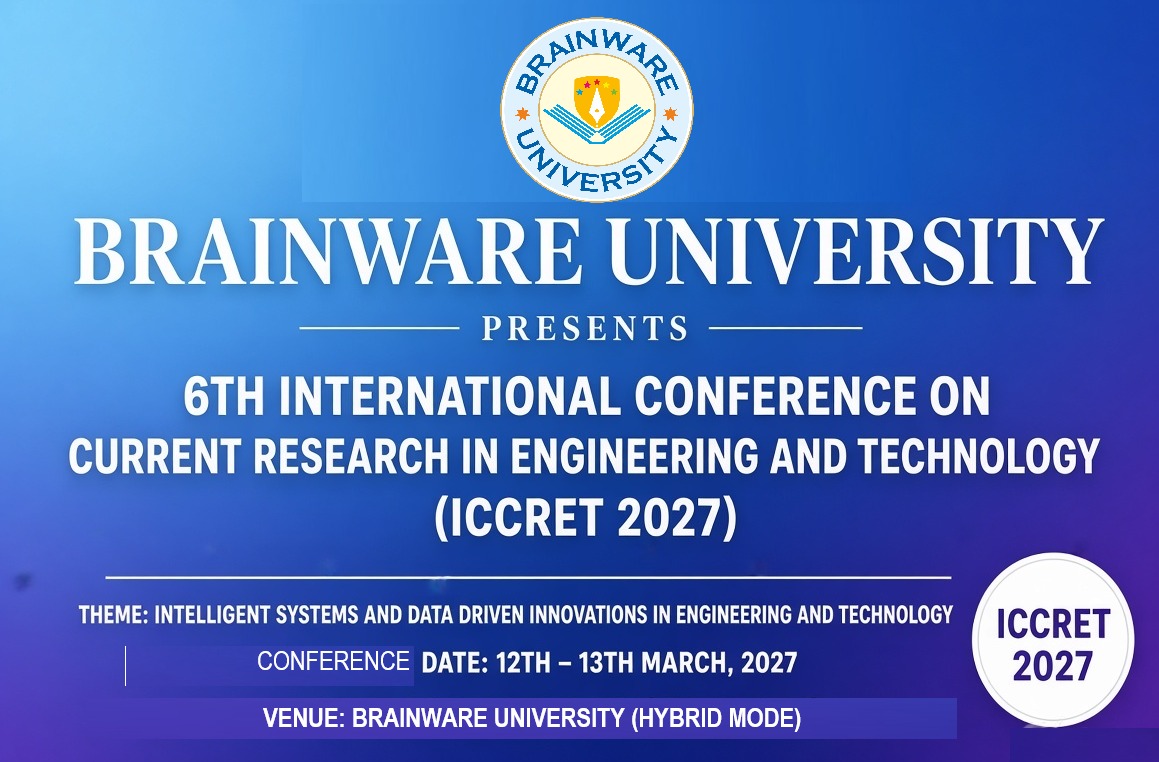
The 5th International Conference on Current Research in Engineering and Technology (ICCRET-2026) invites academic researchers, industry experts, and technology innovators to come together and share their groundbreaking work in the realm of intelligent systems and data-driven innovations.
With its core theme, “Intelligent Systems and Data-Driven Innovations in Engineering and Technology,” ICCRET 2026 aims to highlight transformative trends and real-world applications in AI, machine learning, big data, IoT, cloud computing, and next-gen cyber-physical systems. The conference will provide a platform to discuss innovative models, architectures, and frameworks that are reshaping the landscape of modern engineering and technology.
The conference features four comprehensive tracks covering:
AI & Intelligent Computing
Big Data & Analytics
IoT & Smart Environments
Next-Generation Computing & Security
This year’s edition promises to be an engaging blend of keynote addresses, technical paper presentations, panel discussions, and networking sessions—all within the vibrant academic ecosystem of Brainware University.
As part of ICCRET-2026, the conference will also host an outreach initiative in collaboration with the IEEE Circuits and Systems Society (CASS). This initiative aims to promote knowledge dissemination, student engagement, and industry–academia interaction in the domains of intelligent systems and emerging electronic technologies. Through invited talks, mentorship opportunities, and collaborative discussions, the IEEE CASS Outreach program will provide participants with valuable insights into cutting-edge research trends and professional development pathways, thereby enriching the overall academic and technological impact of ICCRET-2026.
Join us at ICCRET 2026 to present, publish, collaborate, and contribute to the advancement of engineering research in a digitally transformed era.
About the University
The Brainware University, established under the West Bengal Govt. Act 31 of 2015, at Kazipara, Barasat, Kolkata strives to reach out and add worth to people's lives, impart quality education for creating efficient manpower for the future, and promote a superior category of students and researchers who would apply knowledge for the advancement of society and meet the challenges of a rapidly changing world. It aims to spread and enhance education, collaborate with national and international institutions, promote interdisciplinary research work, upgrade educational standards and empower the youth with a holistic development.
The University aims to create a promising environment for producing skillful professionals by making students aware of the modern industrial need. Also encourage fundamental and innovative research in the field of Computer Science & Engineering.
Department of Computer Science and Engineering and Department of Computer Science and Engineering-Artificial Intelligence — collaborates to highlight the pivotal role of computational techniques in solving complex problems and to encourage applied research.
Call for Papers
The International Conference on Current Research in Engineering and Technology (ICCRET-2026)
invites high-quality research contributions from academia, industry, and practitioners
across the globe. Authors are encouraged to submit original, unpublished, and innovative
research articles addressing contemporary challenges and advancements in engineering and
technology. All submissions will undergo a rigorous peer-review process to ensure quality
and relevance.
Accepted and registered papers will be published in the conference proceedings and considered
for publication in reputed indexed journals. Authors are requested to strictly follow the
submission guidelines provided under the “Paper Submission Guidelines” section.
The conference tracks include (but are not limited to) the following areas:
Track 1: AI & Intelligent Computing
Track 2: Data Science & Analytics
Track 3: IoT & Smart Systems
Track 4: Advanced Computing & Security
Deep Learning Architectures for Engineering Problems
Big Data Architectures (e.g., Hadoop, Spark)
IoT Architectures and Protocols
High-Performance Computing for AI Applications
Reinforcement Learning for Control Systems and Robotics
Data Mining and Knowledge Discovery
CPS Design and Implementation
Cloud, Fog, and Edge Computing
Computer Vision and Image Processing in Industrial Automation
Real-time Analytics for IoT and Sensor Networks
Sensor Networks for Smart Environments
Software Engineering for AI/ML
NLP for Engineering Documentation and Analytics
Statistical Modeling and Causal Inference
Intelligent Robotics and Autonomous Systems
5G/6G Communication Networks
Predictive Maintenance and Anomaly Detection
Visualization of Complex Engineering Data
Smart Grids and Energy Management
Quantum Computing for Optimization
AI for Material Science and Design Optimization
Data Security and Privacy
Connected Vehicles and ITS
Blockchain in Engineering
Machine Learning in Renewable Energy Systems
Cloud and Edge Computing
HCI in Smart Environments
Cybersecurity for Networked Systems
Ethical AI and Trustworthy Machine Learning
Data Governance and Quality Management
Security and Resilience of Smart Systems
Bio-Inspired and Evolutionary Computing
Important Dates
Please mark your calendar with the following key deadlines. We strongly encourage authors to submit their work well in advance of the submission deadline to avoid last-minute issues.
Extended Paper Submission Deadline
31st December 2025 15th January 2026
Acceptance Notification
31st January 2026 15th February, 2026
Camera-Ready Submission
15th February, 2026 15th March, 2026
Early Registration Deadline
20th March 2026
Conference Dates
1st – 2nd May 2026
Late submissions will not be considered. Authors are advised to adhere strictly to the deadlines.
Paper Submission Guidelines
Authors are invited to submit original, unpublished research papers aligned with the conference theme:
“Intelligent Systems and Data-Driven Innovations in Engineering and Technology.”
Manuscript Format: Papers must be written in English and formatted strictly following the ITM Web of Conferences template:
Length: 10 to 12 pages (including figures, tables, and references).
Referencing Guidelines:
The article must contain timely, accurate and relevant references. Ensure that a set of references doesn't excessively point to the same author(s) or the same publication with the intention to artificially increase the citations of certain authors. This precaution applies to a single article or a series of articles. Our team will carry out additional checks to eliminate any risk of citation manipulation that could affect the integrity and image of the journal.
Examples for Journal articles:
1. A. Nicolas, J.-L. Barrat, J. Rottler, Effects of inertia on the steady-shear rheology of disordered solids. Phys. Rev. Lett. 116, 058303 (2016)
2. A. Lohrasebi, T. Kozlowski, Modeling water purification by an aquaporin-inspired graphene-based nano-channel. J. Mol. Model. 25, 280 (2019).
https://doi.org/10.1007/s00894-019-4160-y
If available, author(s) must add the DOI number of the article. References must contain the full title of the cited article.
A maximum of 15 references per article is allowed, with only a maximum of 3 citations to proceedings articles. Please note that articles exceeding this quota can be excluded from the publication by the production team.
Include AI Declaration: Any use or proposed use of AI in the writing process must be disclosed at submission, specifying the tool, version, and its role. Authors may use generative AI or AI-assisted tools to improve language, grammar, or clarity, but only under human oversight. Authors must thoroughly review all AI-assisted content, as AI-generated outputs may be inaccurate, incomplete, distorted, out-of-context or biased. The Publisher (EDP Sciences) reserves the right, at its sole discretion, to refuse the publication of any article that is found to contravene EDP Sciences AI policy (https://www.edpsciences.org/fr/politique-de-publication-et-ethique#anchor_AI-and-Ethics).
Submission Process: Manuscripts must be submitted in PDF format through the MicrosoftCMT submission system.
Review Process: Each submission will undergo a double-blind peer review by at least two experts. Authors must ensure that their manuscripts are anonymized prior to submission.
Presentation Requirement: At least one author of each accepted paper must register for the conference and present the work.
Publication: Accepted and presented papers will be published in the ITM Web of Conferences journal. Selected high-quality papers may be invited for publication in indexed journals or edited volumes following the conference.
Indexing: ITM Web of Conferences is indexed in: Conference Proceedings Citation Index (Web of Science) (Subject to acceptance - as for all proceedings journals). CPCI (Conference Proceedings Citation Index) is part of the Web of Science Core Collection.
Acknowledgement: The Microsoft CMT service was used for managing the peer-reviewing process for this conference. This service was provided for free by Microsoft and they bore all expenses, including costs for Azure cloud services as well as for software development and support.
Registration
At least one author of each accepted paper must register to ensure inclusion in the conference proceedings.
All participants are required to register under the appropriate category.
The registration fee includes conference kit, access to all technical sessions, lunch, and refreshments.
Category
Indian Participants
Foreign Participants
Students / Research Scholars
INR 4,500
USD 100
Academicians
INR 6,000
USD 150
Industry Professionals
INR 8,000
USD 200
Listeners/Attendees
INR 2,000
USD 50
Registration Guidelines
At least one author must register for each accepted paper.
The registration fee must be paid using the bank details provided below.
After completing the payment, authors must fill the registration form and upload the payment proof.
Each registration covers presentation of one accepted paper unless otherwise specified.
All authors must ensure correct information is provided during registration.
Papers that are not registered within the registration deadline will not be considered for presentation or publication in the conference proceedings.
Keynote Speakers
Sandeep Shekhawat
Senior Director of Engineering, Walmart Global Tech
Sunnyvale, California, United States
Dr. Nur Alam MD
Kyungdong University Global
South Korea
Prof. Indranil Ghosh
University of North Carolina, Wilmington
United States America
Dr. Soumen Banerjee
Eastern International University
Vietnam
Dr. Himadri Nath Saha
Computer Science, SNEC, Calcutta University, West Bengal
Índia
Dr. Sunipa Roy
Krishnanagar Women's College, West Bengal
Índia
Dr. Mili Sarkar
Chair, IEEE CAS, Kolkata Section
Índia
Dr. Chandrima Mondal
ExCom Member, IEEE CAS, Kolkata Section
Índia
Program Schedule
The following is the updated program schedule based on the finalized conference plan.
Minor adjustments (if any) regarding session chairs and paper allocations will be
communicated closer to the conference dates.
Time
Day 1 – May 1, 2026 (Hybrid Mode)
10:00 – 10:10
Inauguration
Physical
10:10 – 10:20
Welcome Speech (General Chair)
Dr. Shivnath Ghosh
HoD-CSE-AI, Brainware University
Physical
10:20 – 10:40
Speech by Vice-Chancellor
Prof. (Dr.) Sankar Gangopadhyay
Brainware University
Physical
10:40 – 11:00
Hi-Tea
Physical
11:00 – 11:30
Invited Talk
Dr. Himadri Nath Saha
(HOD, CSE, SNEC, University of Calcutta; Core Member, ICEDS) Physical
11:30 – 12:00
Invited Talk
Dr. Sunipa Roy
(Krishnanagar Women’s College, India) Physical